Monday, February 9, 2015

Look at all dem rhytons


I was looking at the rhytons and all the animals in the google results you provided and to be honest, I didn't want to do any four legged animals. It seemed a little over done to me. Also I was looking at an endangered species list online and thought it'd be pretty cool to go a different direction and make rhytons with birds. As for my historical example, I included one of the few bird rhytons I found that I think was dated to 480 BC. I'm going to use the shape and format as inspiration for my kiwi bird rhyton but without the support clay underneath since a kiwi bird is a ball of fluff on it's own so it'll be plenty supported. I really like how it all fits together, it doesnt look awkward and the bird looks very regal. it's standing straight up which I find to look a little better than the rhytons that are at an angle.


I included this rhyton simply to show the shape of the macaw rhyton I'm going to do. I'll probably make more of a bend between the cup and the head for added stability.


P.S. I used the google results for both images.


These are my sketches. I chose birds because I didn't want to do any four legged animals and fish would've been kind of difficult. I had recently done a watercolor close up of a macaw and since then, I've really liked them. I haven't decided if I want to do slip work on it because (1) the black slip on my first assignment didn't turn out to be black and (2) a straight terracotta color macaw would look cool, especially around the eye. Also, I chose the kiwi bird because I saw a youtube animation of a kiwi bird that dreamed of of flying it's whole life (it's flightless) and to acheive that dream, it jumped off a cliff to it's death so it could feel like it's flying and die happy. My heart hurt, it was so sad and cute. Going along with the bird theme, I chose the kiwi, another endangered species of New Zealand. I don't think I'm going to make the heads themselves hollow because if I plan on using them, I don't want to worry about cleaning all the nooks and crannies of the heads. The only thing I'm kind of apprehensive about is the strength of the kiwi bird's beak. I might have to make it slightly thicker than it should be to ensure it won't break off over time.

great whytons

 Looking at all of these rhytons on the Link provided on the syllabus, I noticed a lot of them are of land animals or have 4 legged animals used as the subject matter. For example this rhyton is of a claw probably from a lobster or some sort of crustacean but on it is a horse painted on the side of the claw. So it has a watery influence with the claw but it goes back to these land animals that seem to be so popular.

SOOOOOOOOOO...I decided to maybe make something based off a fish of some sort. Apparently great white sharks and some species of hammer head are considered either endangered or under close watch because theyre close to becoming an endangered species. I liked how some of the rhytons balanced on the animal form or had a slight curve but I was not sure if I should try out that curve and just make it a single tube with an animal head/body a the end. Its either I dont add a shark fin which is usually the cause of them being hunted to endangerment or I make the neck of the rhyton longer allowing more liquid to fill it up and allowing the shark to have some sort of body on the Rhyton form.

Rhytons

 I really like this image because of the ancient designs on the side, and the detail. I like the horns, and also the simple colors used. The shape seems simple also.
I feel like this shape could be a little more difficult since it shows more detail in the jaw and nose.
This one is similar to the one above in terms of colors and the ancient designs, which is what I like.
I chose a lion, because it's my favorite animal; and a fish, because of its simple shape. 

Sunday, February 8, 2015

right on...

It was difficult to find information on rhytons but I think this one is a greek piece, and I like how it swoops back from the front of the animal. Id like to do this with one of mine.


I found this one on the google images link on the syllabus. This one is interesting to me because it doesn't have a big swoopy tube behind it. I think I'll do one of my pieces like this.

These are my sketches. The first is of a sea lion and the second is of a tree kangaroo. Both are endangered species. The sea lion would swoop back with its tube and I want to do the tree kangaroo fatter with it closer to the head like the donkey above.

Rhytons


I'm just doing the fin back whale as a large shallow bowl and the Philippine Eagle as a cup (hollowed  out head). The Saiga is a super funny looking animal and looks like it would be at home in a scifi movie.
 The Fin back whale, or fin whale, is faster than any ocean steamship and is almost 70ft long like many other whale it was hunted in the twentieth century for its blubber, oil, and baleen. Sadly this big guy is still hunted by the Japanese and Greenlanders.
The Philippine Eagle is as big as it sounds with a wingspan of about 6ft it is called the monkey eating eagle for good reason; it eats monkeys. Apparently this huge bird of prey has no predators except the ones (humans) mean enough to want to kill something so beautiful (it has a blue beak and spiky bedhead feathers!). Random fact: if you are caught killing a Philippine eagle you are stuck in jail for 12 years, Philippine law.

Assignment #3 - Rhytons

For my historical piece, I chose this picture from the google search link provided in the syllabus. I couldn't find any rhytons on artaxis or accessceramics. I like the black glaze or slip on the Greek rhytons. I like the contrast compared to the red and white clay we've been using so far, so I would like to use the black slip in this assignment. I like how the cow's shape is accurate. I've never seen rhytons before, so it was a nice surprise to see that these exist.

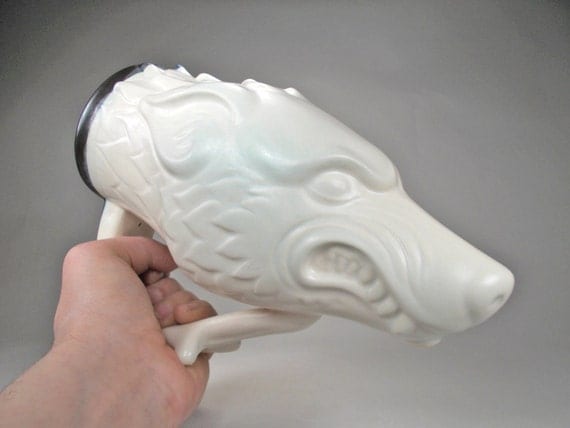
For my contemporary piece, I went to etsy.com and found this one. This piece by Chischilly Pottery is currently for sale for $50.00. It is described as being a rhyton in the shape of a wolf's head. I would like to emulate the great carving and shaping work in this piece, and combine this idea with the classic dark coloring of Greek rhytons.
White Direwolf Rhyton Drinking Horn Style Beer Mug - Original Design Fantasy Art for Renaissance, Medieval Fests, Wolf Lovers Mug
As for the two (or three?) rhytons I am going to make, I would like to do one in the shape of an owl (possibly the Laughing Owl that has gone extinct) and a dog, since dogs are a part of my life. There is the issue about animal rights and proper care for all animals, regardless if they are some exotic big cat or your household pet.
For my drawings, I did these.

Tuesday, January 27, 2015

Plethora of Bowls

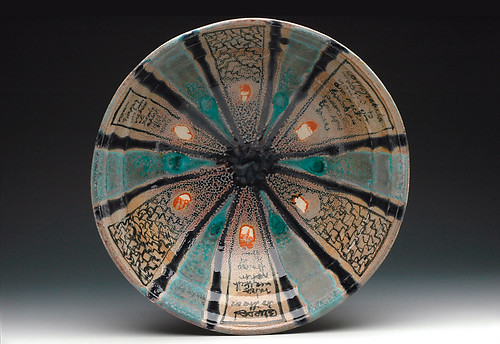
Artist: Chris Baskin

What really speaks to me about this piece is the shapes and colors inside the bowl. The aquamarine blue in the center that fades to a grayish teal is really nice on the eyes. I also like inside the triangular shapes that there's an orange tit so it brings a complimentary aspect. The thick black bold outlines are also really pleasing to look at. The ripples created within the bowl add a great texture to the overall piece.

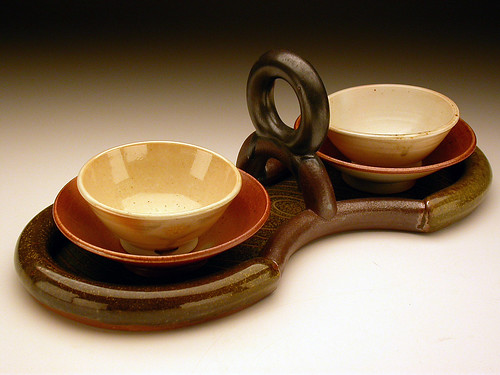
Artist: Tom Rohr

The neutral reddish colors really stuck out compared to the other bowls I was looking at. Also the overall composition is really pleasing to look at. I like the simplicity of the bowls and the cream color they have. The wider bowls holding them is also really great to look at and I love that red-orange color. The stand is really unique and I love the shape the artist went with to make it. The intricate design really makes the piece pop and the colors picked really brings everything together as a set.


Monday, January 26, 2015


This is a bowl made by Linda Arbuckle that I found on AccessCeramics.

I really like the notches in the side of the bowl, and the bright colors, in contrast with the black lines.
I also like the natural design it has on it, which reminds me of autumn. For my bowl, I want it to be for cereal or soup, and simple, yet with bright colors.


http://accessceramics.org/results/object/1/

I really like the shape of this bowl by Louis Reilly. I like the ridge on the feet of the bowl as well as the outward curvature on the lip of the bowl. I think I will try to embody this type of look in my bowl. I also really like the soda fired technique on the outside of the bowl, I think it is very cool looking.


http://accessceramics.org/results/object/1/

What stood out to me from this piece by Victoria Christen was the four edges in the lip of the bowl. Not only do I think that it gives the bowl some flare, but I also think that it would be a practical bowl to drink from these edges without the substance sloshing around the sides. I wonder if this is something that I will be able to incorporate into my bowls.


Bowls and More Bowls

30 bowls? Seems like a crazy amount of dishes. Although, I do have a rather large family. Perhaps I can invite everyone over for soup.

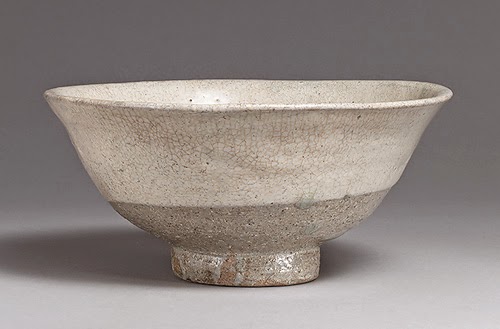
Seriously though, I have a thing for sets and things that match. First a look at a historical bowl. I found this one (thanks to one of the links) that I really like. Its a Chinese tea bowl. I really like how its  shaped, and how the emphasis is more on practicality not on beauty.

http://www.metmuseum.org/toah/works-of-art/91.1.226
Song Dynasty Tea Bowl


I love bowls that are at more of an angle on the sides. Really, what is the point of a bowl when the sides are so flat it looks like a plate? You can't eat cereal from a plate, well maybe you can but I sure can't. For my bowls I hope to make something that is deep and can hold a good amount of ice-cream. 

For my modern bowl I found this one on AccessCeramics. It too has the nicely sloped sides. I really love the color of this one. It has a down to earth feel, and it looks very organic and natural. Like the tea bowl above it is functional and beautiful without shouting in your face about design. 

http://accessceramics.org/results/technique/7/
Jan Schachter, Thrown, 2011

Some Sketches. I want to have deep bowls. I have no idea how I want to decorate them yet. I considered what a square bowl would be like, but I am not sure if you can make a square bowl on the wheel. Perhaps a bowl with a square foot. 


Bowls

This is a bowl by Edward C. Moore. I enjoy the simple shape of the bowl and the color used. I also like the foot of the bottom of the bowl.
These pieces were made by Hayne Bayless. I really like the square shape to them, and the curved edges. I want to experiment with different shapes, so this is one i can consider.
My ideas include doing one decently big bowl, and maybe doing them to fit inside of each other too. Also maybe doing a square shaped one.

Assignment 2 | Kirsten Cox

HISTORIC

Bowl, Ptolemaic Period, ca. 200–150 B.C., Egyptian
The contrasting colors and patterns really stood out. The wave-crest pattern is something I would like to try myself. It is a historically common pattern so there would be opportunities for me to look at different techniques and experiment.

Trophy Bowl, Don Reitz © 1980

This bowl’s intricate and detailed accents along with the organic splashes of colors caught my eye. The gradient colors within the bow are just as interesting as the uniqueness of the outside. This piece is inspirational for our next assignment because of the additions to the handles and rim.


SKETCHES

I want to experiment with shallow bowls and adding handles and/or accents.


my helper

Assignment 2


This is the historical peice made by Harrison McIntosh in 1960. I feel like the patterns n the outside reflect a lot of what patterns were popular back then. There was a lot of bubbly, round, fluid imagery in the 60's and that's shown here. Even in the shape of the bowl, it looks bulbous and hard to hold, like it would just be used for serving or something. This was on AccessCeramics.


These are Hayne Bayless's bowls I got from AccessCeramics. I love the idea of having bowls and dishes of weird shapes, like triangle bowls or square cups. The firing and glaze look beautiful on these. He used a cone 10 temperature with copper glaze and resist. I know we can't really make non-circle bowls on a wheel but I want to make something like these eventually.


This sis a fractal serving dish by Sarah House, also on AccessCeramics. What i love about these is, not only the color and finishes, but that they're really handy. You could use them altogether or each one as an individual bowl (except maybe the smallest bowls). These serve a variety of purposes and probably also take up less space in the cupboard haha.


These are my plans. I don't know what I want to do in terms of decoration, I"ll figure that out along the way. I think it'd be cool to have a big bowl with a little silverware holder for those times when the spoon is too short to lean on it properly and it falls in your food. A lot of this is driven by convenience and use so far, I might just end up doing the tri-point bowls later, I don't know.


Sunday, January 25, 2015

Bowls on bowls with bowls

Fist off this is pretty awesome. These are the fractal serving dishes made by Sarah house found on Access Ceramics. A whole set of bowls that fit together!! I like this a lot because of the glazes used and the simple yet interesting design of these bowls.


 The simple design of these japanese bowls that have textured designs of animal fur on the outside of the bowls. The texture is what I like most about these bowls since they show detail to simulate fur of animals that they probably hunted.

these are a few designs inspired by the ones above to see how it would all turn out if I did something similar or not. The designing of the glaze textures would be pretty simple but maybe some texture on the bowls would be pretty cool too..

Assignment #2


For my historic piece, I chose this tea bowl from metmuseum, made by Tanaka Chojiro from around 1575. I am majoring in Japanese, so this bowl caught my eye. I enjoy the rough texture this piece has. Although this piece was not wheel thrown, I might try to emulate the rough texture and look on some of the bowls I make for this assignment.  I also enjoy that I can see bits of the clay peeking through the black glaze.


For my contemporary piece, I chose this bowl from accessCeramics. Around the studio, I see a lot of people's work having "rings" around their bowls, and this bowl from Ginny Marsh seems to be very smooth. The glaze is also fantastic. I like the rough look of the bits of black in the middle of the piece, and also with the edges joining with the orange and blue colors as well. AccessCeramics states that this piece's glaze is layered, Also, I'm not sure if there's glitter on this bowl or not (it looks sparkly where the light hits it? I don't know). I don't think glitter would be allowed in the studio, so I think I'll stick to the standard slips and glazes we have available to us.


For my pieces, I want to try to incorporate either the glaze technique from Ginny Marsh, or get the rough feel from the Japanese bowl. I don't even know if a rough texture is possible with the wheel, as I've never done it before. As for the decorations on my bowls, I might try to add some animals representing the types of food that goes in my bowls. For example, maybe I would add a deer to a bowl that would contain only vegetarian meals. I might try to get fancy and add some mythological animals to my bowls (we'll see how that goes).

Bowls

 The first bowl is by Ben Krupka, and I found it on access ceramics. I really enjoy the simplicity of this piece and how its slightly altered after being thrown. The subtle design is something id like to add to my work.
This bowl is a Korean artifact from the sixteenth century, and I found it on metmuseum. Its very similar to the contemporary piece but I think I like the shape more when it pulls out further at the top.
This is my s
ketch, I am thinking of trying to keep the simplicity of the two pieces I found with some nice details of vegetables and fruit. Haven't quite decided what fruits and veggies yet though.

Wednesday, January 14, 2015

Assignment 1


These are plates by Sean O'Connell called "Nonagonal Plates". What really drew me to these was the diagonal lines in the outer circle that bend when they touch the ring. I love how the line thickness changes to create a kind of jagged movement towards whatever's on the plate. I can imagine it would make it uneasy for some people to eat off this with the pattern but personally, I'd see it as a wonderful visual accent to the meal.


This tea set is by Tom Rohr and is called "Coffee Service". I'm attracted to the finish and the color og the glaze for these pieces. I love how he made a ceramic set look like molten metals. He used glaze at a highfire temperature. I don't know if it's a certain glaze that acheives the metal look or how it was fired but I hope to put a metallic finish on my work. 


My plans. I hope to have a white pearly finish with matte dots and accents but I don't know if I'll end up doing this design.